











Hope you enjoy reading this blog post.
If you want the Moris Media Team to help you get more traffic, just book a call.
Friday, 14 August 2026

Written by :
Akanksha Kapoor
SENIOR DIGITAL CONTENT WRITER
August 23rd, 2023
 1040
1040
Moris Media, India’s leading PR & Digital marketing agency congratulates and celebrates the prestigious & historical Lunar Mission by ISRO- Chandrayaan-3 and delves further into the intricate specifications & details of the ambitious lunar mission, global competition and way forward.
The space agency for India, the Indian Space Research Organisation (ISRO) works in science, engineering, and technology to help India and humanity benefit from space technology. The Department of Space (DOS) of the Indian government includes ISRO as a key component. The department primarily uses different ISRO Centres or Units to carry out the Indian Space Programme.
The Indian National Committee for Space Research (INCOSPAR), which was founded by the Indian government in 1962 as Dr. VikramA Sarabhai's idea, was the predecessor to ISRO. On August 15, 1969, ISRO was established, replacing INCOSPAR with an expanded mandate to utilise space technology. In 1972, DOS was established, and ISRO was included in DOS.
The development and use of space technology for diverse national needs is ISRO/DOS's main goal. Major space systems for communication, television broadcasting, and meteorological services, resource monitoring and management, and space-based navigation services have been built by ISRO to achieve this goal. To place the satellites in the necessary orbits, ISRO has created the PSLV and GSLV satellite launch vehicles.
ISRO advances technology while also advancing research and science education in the nation. Under the direction of the Department of Space, a number of specialised research centres and independent institutions for remote sensing, astronomy and astrophysics, atmospheric sciences, and space sciences generally operate. In addition to supplying useful information to the scientific community, ISRO's own Lunar and Interplanetary Missions and other scientific programmes support and promote science education.
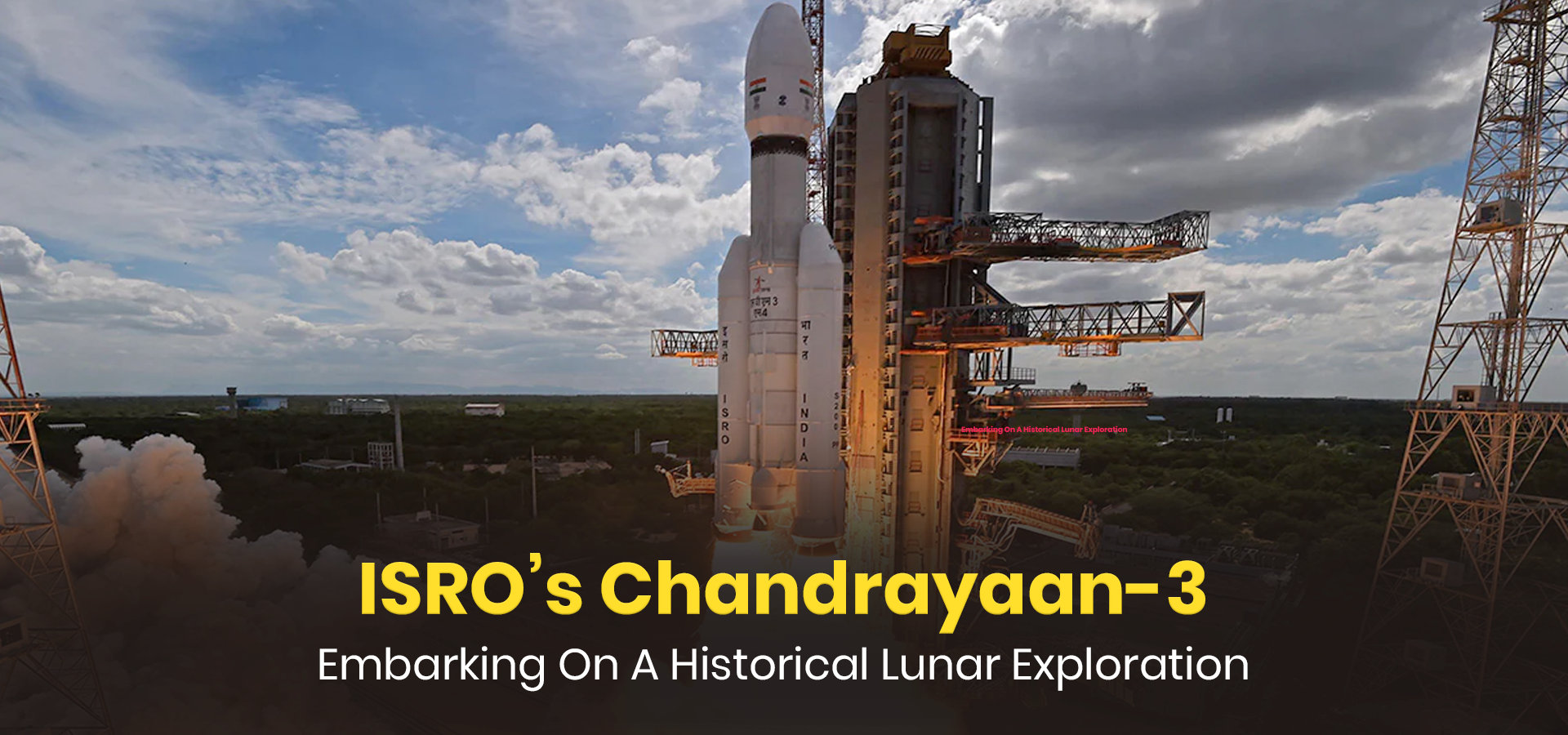
In order to demonstrate end-to-end capability in safe landing and wandering on the lunar surface, Chandrayaan-3 is ISRO’s follow-up mission to Chandrayaan-2.
LVM3 (Launch Vehicle Mark 3) launched it on 14 July 2023, at 2:35 pm IST as scheduled, from Satish Dhawan Space Centre Second Launch Pad in Sriharikota, Andhra Pradesh, India. Chandrayaan-3 is scheduled to land on the south pole of the moon surface on 23rd August, 2023.
With the aim of researching and showcasing new technology necessary for interplanetary missions, Chandrayaan-3 is made up of:
1. An indigenous Lander module (LM),
2. Propulsion module (PM), and
3. Rover.
The Lander will be able to soft land at a chosen location on the moon and release the Rover, which will conduct in-situ chemical analysis of the lunar surface while it is moving. There are scientific payloads on the Lander and the Rover that will conduct lunar surface tests. The main job of PM is to transport the LM from injection into the launch vehicle to the final 100 km circular polar orbit of the moon and then to release the LM from PM. In addition to this, the Propulsion Module features one additional scientific payload that will be functional after the Lander Module has been separated. LVM3 M4 has been identified as the launch vehicle for Chandrayaan-3, and it will deposit the integrated module in an Elliptic Parking Orbit (EPO) with a dimension of approximately 170 x 36500 km.
The mission objectives of Chandrayaan-3 are:
1. To demonstrate Safe and Soft Landing on Lunar Surface
2. To demonstrate Rover roving on the moon and
3. To conduct in-situ scientific experiments.
To achieve the mission objectives, several advanced technologies are present in Lander such as:
Altimeters: Laser & RF based Altimeters
Velocimeters: Laser Doppler Velocimeter & Lander Horizontal Velocity Camera
Inertial Measurement: Laser Gyro based Inertial referencing and Accelerometer package
Propulsion System: 800N Throttleable Liquid Engines, 58N attitude thrusters & Throttleable Engine Control Electronics
Navigation, Guidance & Control (NGC): Powered Descent Trajectory design and associate software elements
Hazard Detection and Avoidance: Lander Hazard Detection & Avoidance Camera and Processing Algorithm
Landing Leg Mechanism.
Luna 25, Russia’s first moon mission in the last 5 decades, now competed with India’s Chandrayaan-3 in its race to the moon and the world’s first spacecraft to land on the South pole of the lunar surface.
Nearly a month after the launch of Chandrayaan-3 on 14th July, 2023, Russia's lunar mission lifted off 12th August, 2023. Both the missions are indeed in a race for touch down on the farther side of the Moon which is a major milestone as it would make either of the two countries the first one to do so in history.
Luna-25 may aim to land on the south pole of the moon between August 21 and 23, despite Chandrayaan-3's soft landing attempt on August 23 being announced by the Indian Space Research Organisation (ISRO). Both missions have unique designs and have various research goals.
But will India’s slow and steady mission win the race?
According to the BBC, the Russian mission may take "slightly longer" than anticipated, suggesting that Chandrayaan-3 may ultimately touch down on the Moon before it.
According to the report, Wendy Whitman Cobb, a professor of strategy and security studies at the Air University of the US Air and Space Force, believes that India has a "leg up" because Chandrayaan-3 is already in lunar orbit.
The Russian and Indian vehicles are competing to search for water ice and potentially useful minerals on the southern side of the moon. Scientists believe that the moon's south pole has pockets of water ice.
Only time will tell, which out of the two space missions is the first one to land successfully on the moon’s surface.
What is essential, that both missions are able to capture intricate and critical information about the lunar surface & properties, and carry out the scientific experiments successfully.
Liked reading this blog? Spread the word!




The Power of Team Calendar: Boosting Efficiency and Collaboration with moCal
Read More
Mastering Business Time Management with moCal's Online Calendar For Business
Read More
Unlocking Seamless Collaboration with moCal's Online Shared Calendar
Read More
Unlocking the Power of 7-in-1 moCal: Redefining Efficiency in Modern Business
Read More
Elevating Personal Branding: The Moris Digital Doctors Prescription
Read More


If you want the Moris Media Team to help you get more traffic, just book a call.




We hate spam as much as you do