










Hope you enjoy reading this blog post.
If you want the Moris Media Team to help you get more traffic, just book a call.
Wednesday, 24 June 2026

Written by :
Kaushik Chakraborty
SALES AND MARKETING DIRECTOR
April 11th, 2023
 1160
1160
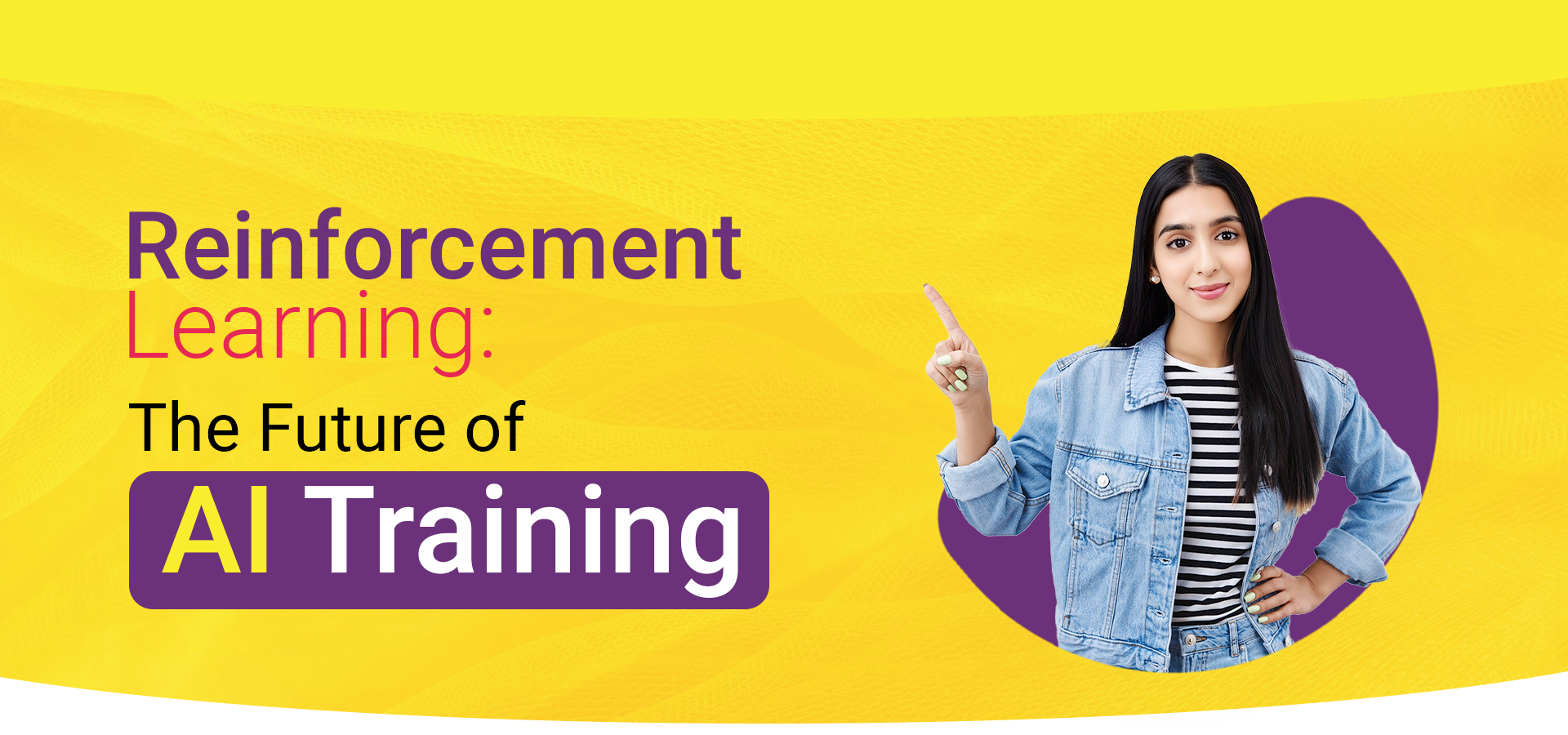
In the past few decades, artificial intelligence (AI) has progressed quickly, evolving from basic decision-making algorithms to sophisticated systems that can learn and get better on their own. data science, machine learning, and artificial intelligence have dominated the tech buzzword dictionary. Machine learning has permeated every field, whether it is through films that foresee the threat of an algorithmic takeover or the progressive obliteration of roadways by self-driving vehicles. Reinforcement Learning (RL), one of the most promising areas of AI, has the potential to completely change how we teach machines to do tasks.
Moris Media, the leading digital marketing agency in India, is known for adopting new technologies that have the potential of upscaling different processes. Our experts discuss the concept of Reinforcement Learning and how it's influencing AI training.
A type of machine learning called reinforcement learning enables an agent to learn by interacting with its surroundings. RL employs a trial-and-error methodology to learn how to accomplish a goal, as opposed to supervised learning, where the machine is trained on labelled data, and unsupervised learning, where the machine learns patterns in unlabelled data.
In real life, an agent interacts with its surroundings and gains knowledge from the rewards and punishments it encounters. By choosing activities that result in the intended outcome, the agent fulfils its objective of maximising rewards over time. When the agent takes an activity that is desired, it is rewarded; when it takes an action that is unwanted, it is penalised.
Robotics, video games, and banking are just a few of the industries where RL has been successfully used. One of the most well-known instances of RL in action is the Google DeepMind AI programme AlphaGo, which defeated the Go world champion. AlphaGo honed its game skills by competing against itself countless times and adjusting its tactics in response to the results.
Robotics is a field where RL is used to teach machines how to do difficult tasks through trial and error. For instance, a robot arm that interacts with its surroundings and experiences incentives or consequences for its actions can learn how to pick up and move objects.
However, The majority of businesses don't create video games, robots, or sailing ships. Reinforcement learning, according to experts, can nevertheless be useful in more conventional commercial settings as well. Researchers believe that Reinforcement Learning is not only facilitating acceleration and improvement of design, it is also being used for performing a number of complex activities. This includes choosing to use products that can respond quickly and correctly to shifting behavioural patterns of customers, speeding up trials to rectify challenges in healthcare and financial segments, and solving many critical logistic issues.
Furthermore, you do need to gather huge amounts of data to get this operational due to the trial and error functioning style that Reinforcement learning adopts. Instead, it works best in situations where an action or sequence of events is quickly established and feedback is obtained quickly to determine the next course of action. Thus, whereas optimising customer lifetime value over years is not an appropriate use case for reinforcement learning, a stock market algorithm that can take hundreds of actions each day is.
The potential of RL in AI training is enormous. RL has the ability to make machines truly autonomous, where they can learn and adapt to new environments without human intervention. This is especially important in fields like healthcare, where machines can learn how to diagnose and treat diseases by interacting with patients and medical professionals.
Given its wide range of uses, it would be fairly predictive to suggest that Reinforcement Learning has a promising future. In contrast to other machine learning techniques, reinforcement learning (RL) produces real-world judgements based on a reward system, closely imitating human behaviour. When the goal of our problem statement is obvious, but there is no apparent path to get there, this serves as an ideal resolution. RL can assist machines in better learning how to collaborate with people. Machines these days are observing human behaviour and taking references to learn faster the art of cooperating and interacting with humans.
Reinforcement Learning, however, is still at a nascent stage and needs more finetuning. A major challenge pertains to getting adequate information for training the machines effectively. Millions of interactions between the agent and the environment are required for effective RL, which can be time- and resource-intensive. The requirement for explainability in RL poses another difficulty. It can be challenging to comprehend why machines make particular decisions because they learn through making mistakes. It might be difficult to trust robots because of this lack of transparency, especially in important applications such
Reinforcement Learning has the potential to transform how we train machines to perform tasks. By enabling machines to learn through trial-and-error, RL can make machines truly autonomous and adaptive. However, there are still challenges that need to be addressed before RL can be widely adopted in critical applications. As the field of RL continues to evolve, it is clear that the future of AI training is bright.
Liked reading this blog? Spread the word!




The Power of Team Calendar: Boosting Efficiency and Collaboration with moCal
Read More
Mastering Business Time Management with moCal's Online Calendar For Business
Read More
Unlocking Seamless Collaboration with moCal's Online Shared Calendar
Read More
Unlocking the Power of 7-in-1 moCal: Redefining Efficiency in Modern Business
Read More
Elevating Personal Branding: The Moris Digital Doctors Prescription
Read More


If you want the Moris Media Team to help you get more traffic, just book a call.




We hate spam as much as you do